OWLL

LOCUS

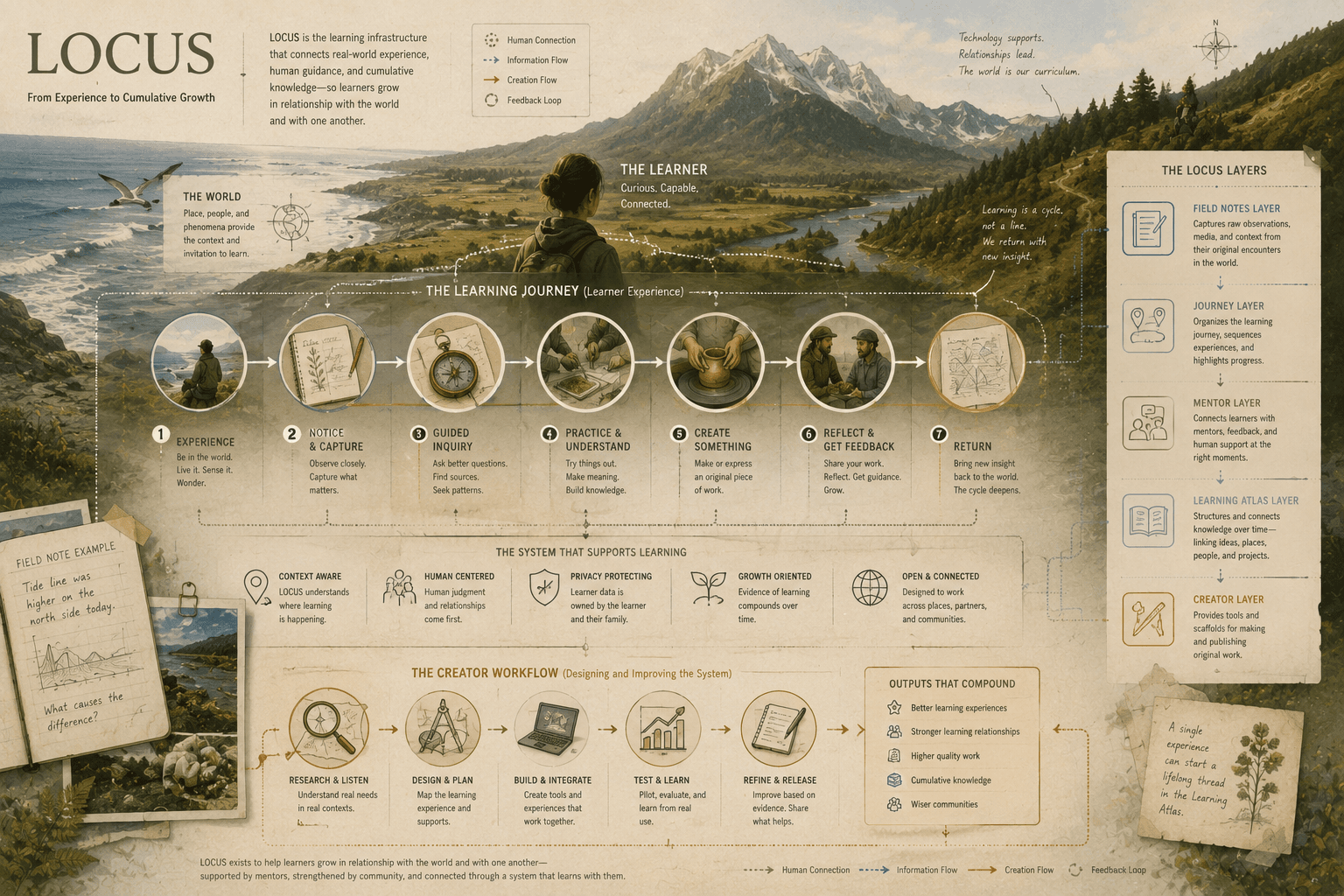
LOCUS helps connect real-world experience, Field Notes, guided inquiry, practice, mentorship, creation, reflection, and cumulative growth.

What LOCUS is

LOCUS helps connect real-world experience, Field Notes, guided inquiry, practice, mentorship, creation, reflection, and cumulative growth.

It is not simply an AI tutor. It is the emerging learning and creator infrastructure behind open-world education.

One complete learner journey

  1. 1

    A learner encounters a place, problem, or prompt.

  2. 2

    The learner records a Field Note.

  3. 3

    A meaningful question emerges.

  4. 4

    Guidance connects the learner to inquiry and sources.

  5. 5

    The learner practices or investigates.

  6. 6

    The learner creates an artifact.

  7. 7

    A mentor responds.

  8. 8

    The experience becomes part of a growing Learning Atlas.

  9. 9

    The learner returns to the world with sharper perception.

LOCUS in One View

LOCUS in One View
Conceptual system plate showing how LOCUS connects real-world experience, Field Notes, guided inquiry, mentorship, creation, feedback, and cumulative learning.

What LOCUS is not

  • Not an AI tutor or chatbot with educational branding
  • Not a replacement for teachers
  • Not a screen-first learning platform
  • Not a points-and-badges layer
  • Not a system designed to automate every human decision

Core layers

After one learner journey, the wider system can be understood as connected layers.

  1. Field Notes

    Observations, questions, media, and evidence gathered in context from real-world experience.

  2. Journey Layer

    Structured pathways that turn curiosity into guided inquiry, practice, and creation.

  3. Mentor Layer

    Human feedback, facilitation, and judgment that remain central to the learning process.

  4. Learning Atlas

    A cumulative record of artifacts, reflection, and growth that sharpens future perception.

  5. Creator Layer

    Tools and workflows that help learning designers build, test, and revise journeys.

Illustrative observation record

Illustrative specimen — not actual learner data. Shown to demonstrate how a Field Note might move through inquiry.

The waterline appears higher on one side of the path.

Is the difference caused by tide, elevation, wind, drainage, or something else?

Time
Tuesday, 9:14 a.m.
Location
North trail bend, approximate
Sketch
Field sketch placeholder
Weather
Light wind from the east; overcast
Measurement
Relative height noted; no instrument

What evidence would help you distinguish between a temporary condition and a persistent pattern?

Sample explanation: the difference may reflect tidal timing combined with slight elevation change along the path. Further observation at different times would help confirm.

Annotated field-guide entry comparing waterline marks across visits.

On returning, the learner might notice whether the pattern holds at low tide, after rain, or during different wind conditions.

Intelligence—real and simulated

Some early prototype functions may initially be manually facilitated, rule-based, or simulated in order to understand what the product genuinely needs before automating it.

The purpose of the prototype is not to pretend that complete artificial intelligence already exists. It is to identify where intelligence adds educational value, where human judgment remains necessary, and how the complete learning loop should function.

What currently exists

A public system description, educational architecture outline, and early prototype design direction. Production platform, creator methodology, and internal systems remain in development.

What remains future work

Full platform development, automated Field Notes tooling, creator workflows, mentor dashboards, Learning Atlas visualization, and validated learning-loop prototypes in real educational contexts.

Start a product conversation

OWLL is interested in conversations about product design, learning infrastructure, and technology collaboration — not procurement or enrollment.